
As global demand for natural food ingredients continues to develop, international buyers are paying closer attention to more than just product quality. Efficient logistics, reliable delivery schedules, and cost-effective transportation have become equally important in global agricultural trade.
Among the natural sweeteners gaining attention in international markets, coconut sugar stands out for its distinctive caramel-like flavor, versatility, and connection to traditional tropical agriculture.
Indonesia is an important source of coconut sugar, supplying international markets with products derived from locally cultivated coconut palms. However, for importers and distributors, sourcing the right product is only one part of a successful purchasing decision. Choosing the right shipping method is equally essential.
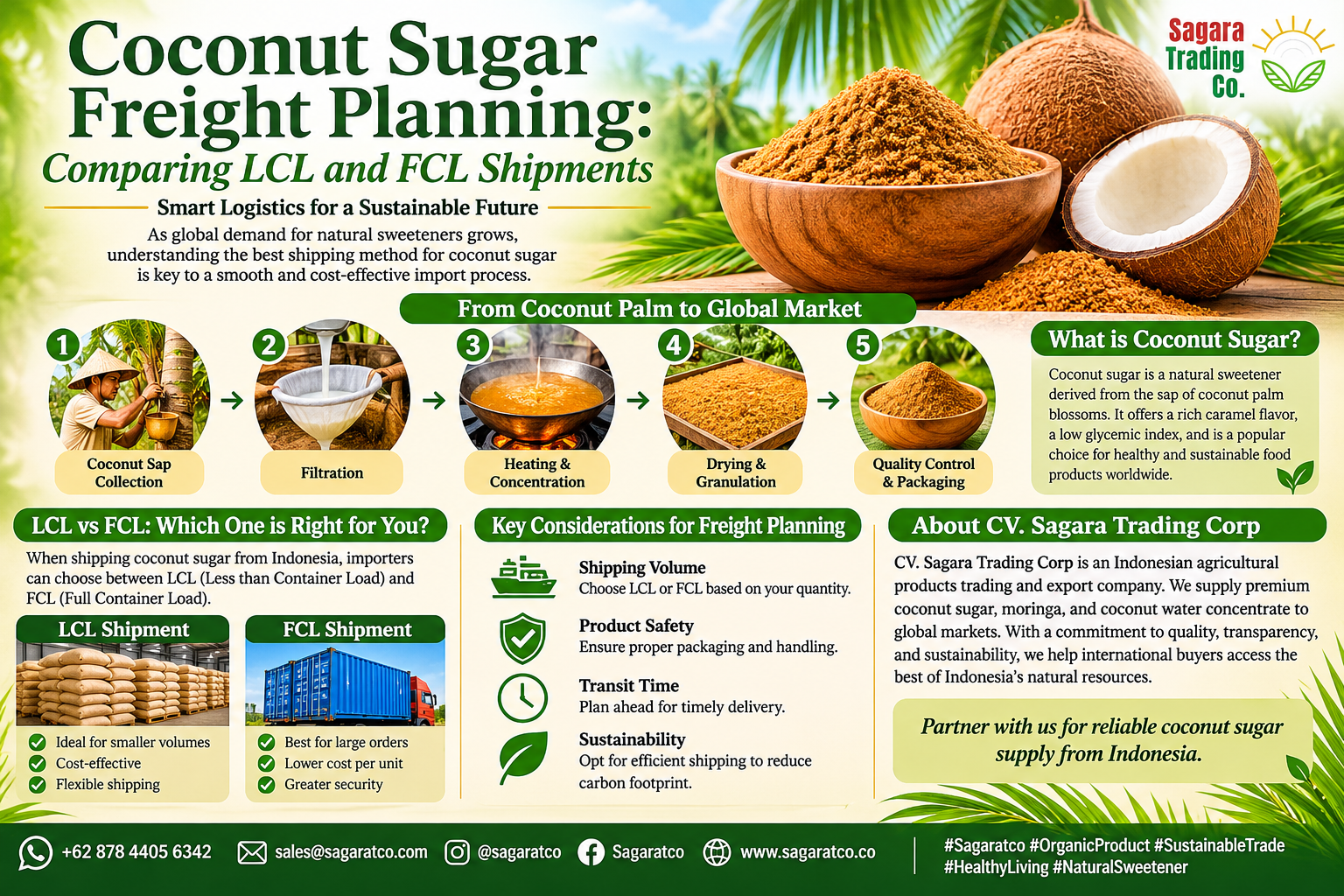
When exporting coconut sugar from Indonesia, two common ocean freight options are Less than Container Load (LCL) and Full Container Load (FCL). Understanding the differences can help bulk buyers manage transportation costs, protect product quality, and plan their supply chains more effectively.
Understanding Coconut Sugar and Its Export Potential
Coconut sugar is a natural sweetener made from the sap of coconut palm blossoms (Cocos nucifera). The sap is collected, filtered, heated, and concentrated before being processed into granules or powder.
Its natural caramel aroma and rich flavor make coconut sugar suitable for various food applications, including:
-
Bakery products, cakes, and confectionery.
-
Coffee, tea, and specialty beverages.
-
Chocolate and dessert formulations.
-
Sauces, marinades, and food seasonings.
-
Plant-based and natural food products.
Coconut sugar also contains naturally occurring minerals, although it remains an added sugar and should be consumed in moderation.
As international interest in traceable agricultural ingredients grows, Indonesian coconut sugar offers opportunities for importers seeking distinctive ingredients for food manufacturing, retail distribution, and wholesale markets.
What Are LCL and FCL Shipments?
Before arranging an international coconut sugar shipment, buyers should understand the two primary ocean freight options.
1. LCL (Less than Container Load)
LCL shipping is designed for cargo that does not require an entire shipping container.
Under this arrangement, coconut sugar shipments share container space with goods belonging to other exporters or importers.
Key advantages of LCL shipping:
-
Suitable for smaller purchasing quantities.
-
No need to pay for an entire container.
-
Flexible for initial orders and product trials.
-
Allows importers to manage inventory in smaller batches.
However, LCL shipments may involve additional handling during cargo consolidation and deconsolidation. Transit times can also be affected by warehouse schedules and the availability of consolidated cargo.
For coconut sugar, buyers should pay particular attention to moisture protection and cargo compatibility during shared-container transportation.
2. FCL (Full Container Load)
FCL shipping means that an importer books an entire container for their shipment, even if the container is not necessarily filled to its maximum capacity.
This option is generally suitable for larger coconut sugar orders and businesses with established purchasing volumes.
Key advantages of FCL shipping:
-
Greater control over the shipping container.
-
Reduced handling compared with consolidated cargo.
-
Better suitability for larger purchasing quantities.
-
Potentially lower freight costs per unit at sufficient volume.
-
More straightforward cargo planning and scheduling.
FCL is particularly attractive for importers, wholesalers, and food manufacturers purchasing Indonesian coconut sugar regularly.
LCL vs FCL: Which Shipping Method Is Better?
Choosing between LCL and FCL depends on shipment volume, destination, delivery schedule, and total logistics costs.
|
Consideration |
LCL Shipping |
FCL Shipping |
|
Cargo volume |
Smaller shipments |
Larger shipments |
|
Container space |
Shared |
Dedicated |
|
Initial cost |
Usually lower |
Usually higher |
|
Cost per unit |
Can be higher |
Often lower at sufficient volume |
|
Cargo handling |
More handling stages |
Generally fewer handling stages |
|
Best suited for |
Trial and smaller orders |
Bulk and recurring orders |
There is no universal answer. The most economical option depends on the complete logistics quotation, including origin charges, destination charges, handling, customs clearance, and inland transportation.
5 Important Factors When Planning Coconut Sugar Freight
1. Understand Your Shipment Volume
Start by calculating the total cargo weight, packaging dimensions, and estimated shipment volume in cubic meters (CBM).
These measurements help freight forwarders determine whether LCL or FCL is more suitable.
2. Protect Coconut Sugar from Moisture
Coconut sugar can absorb moisture from its surroundings, potentially causing clumping and affecting product quality.
Importers should consider:
-
Properly sealed food-grade packaging.
-
Moisture-resistant secondary packaging.
-
Clean, dry, and odor-free containers.
-
Appropriate moisture-control measures.
-
Careful handling during loading and unloading.
These precautions are particularly important for long-distance ocean transportation.
3. Compare Total Freight Costs
Do not evaluate shipping options based only on the initial freight rate.
Consider the complete landed cost, including freight, handling charges, insurance, customs duties, port charges, and delivery to the final warehouse.
4. Plan Transit Time and Inventory
International shipping schedules can change due to port congestion, vessel availability, and customs procedures.
Importers should plan purchasing schedules with sufficient inventory buffers to avoid unnecessary production or distribution interruptions.
5. Consider Sustainable Logistics
Efficient freight planning can contribute to more responsible international trade.
Consolidating smaller shipments or maximizing container utilization can improve transportation efficiency and reduce unnecessary shipping space.
For businesses sourcing sustainable agricultural ingredients, logistics efficiency is another important part of responsible supply chain management.
Why Choose Indonesian Coconut Sugar from CV. Sagara Trading Corp?
CV. Sagara Trading Corp is an Indonesian coconut sugar trading and export company focused on connecting Indonesia's agricultural potential with international markets.
Our product portfolio includes organic and conventional coconut sugar, moringa powder, and coconut water concentrate.
We understand that international buyers need more than access to agricultural products. They also need professional communication, clear product specifications, reliable sourcing, and careful export preparation.
Through our business network and commitment to quality, transparency, and sustainability, we aim to support importers, distributors, wholesalers, and food manufacturers seeking Indonesian agricultural ingredients.
Whether you are exploring an initial coconut sugar order or planning regular bulk purchases, we welcome opportunities to discuss your product requirements, packaging preferences, and export arrangements.
Our vision is to introduce the quality and potential of Indonesian agricultural products to international markets while building long-term business relationships.
CV. Sagara Trading Corp — Connecting Indonesian Agricultural Excellence with Global Markets.
Get in Touch CV. Sagara Trading Corp
Looking for a reliable Indonesian coconut sugar supplier or interested in bulk purchases? Let's discuss your sourcing requirements and explore opportunities for international cooperation.
CV. Sagara Trading Corp
-
WhatsApp: +62 878 4405 6342
-
Email: sales@sagaratco.com
-
Instagram: @sagaratco
-
Facebook: Sagaratco
-
Website: https://www.sagaratco.com
From Indonesia to the World. Quality, Transparency, and Sustainable Trade.
#Sagaratco #CoconutSugar #IndonesiaCoconutSugar #CoconutSugarSupplier #OrganicProduct #SustainableTrade #NaturalSweetener #CoconutProducts #IndonesianExport #BulkCoconutSugar #CoconutFarmers #FoodIngredients #GlobalMarket #ExportLogistics #LCLShipping #FCLShipping #SustainableFood #CVSagaraTradingCorp
Category:


