
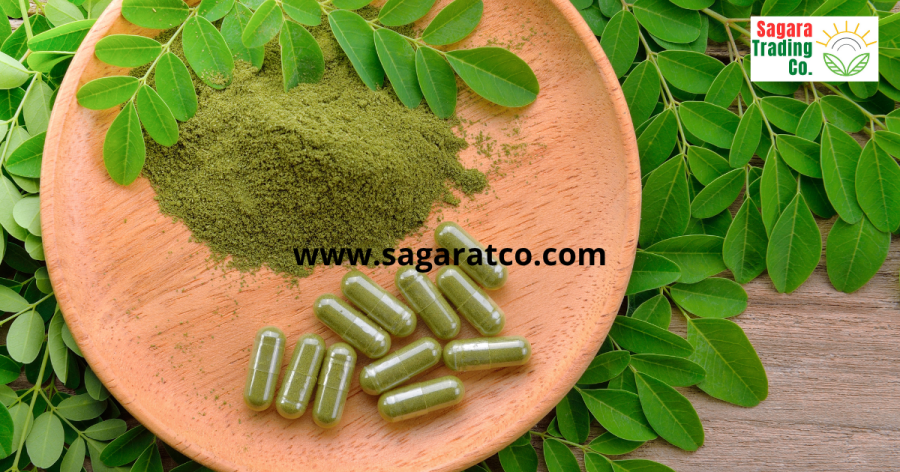
The global demand for moringa powder continues to grow as consumers and food manufacturers look for natural, plant-based ingredients with nutritional value and versatile applications. Made from the leaves of Moringa oleifera, moringa powder is increasingly used in functional foods, beverages, supplements, bakery products, nutrition bars, and wellness formulations.
While factors such as harvesting, drying, and storage are widely recognized as important indicators of moringa quality, particle size is another critical specification that deserves attention. The size and uniformity of powder particles can influence how moringa behaves during processing, mixing, packaging, and consumption. For B2B buyers, understanding particle size can therefore help manufacturers select the right moringa powder for a specific product application.
What Is Moringa Powder Particle Size?
Particle size refers to the dimensions of individual particles within a powdered ingredient. Moringa leaf powder can be processed into different particle-size distributions depending on the milling and sieving techniques used.
A finer moringa powder contains smaller particles, while a coarser powder contains larger particles. The goal is not necessarily to produce the finest possible powder. Instead, the ideal particle size depends on the intended application.
For example, a beverage manufacturer may prioritize a fine, uniform powder for better dispersion, while another food manufacturer may prefer a slightly coarser powder for a particular formulation or processing method.
Why Particle Size Matters for Moringa Powder Quality
Particle size can influence several physical properties of moringa powder.
1. Mixing and Uniformity
A consistent particle size can help manufacturers achieve more uniform distribution when moringa powder is blended with other ingredients. This is particularly important for commercial products manufactured at scale.
If particles vary significantly in size or density, the ingredients may separate during transportation, handling, or production. Consistent milling and sieving can help reduce this issue.
2. Solubility and Dispersion
Moringa powder is a plant-based leaf powder rather than a completely soluble ingredient. However, particle size can affect how quickly and evenly it disperses in liquids.
Finer particles generally provide a greater surface area, which may improve dispersion in applications such as smoothies, powdered beverages, and certain tea or functional drink formulations.
Manufacturers should still conduct formulation trials because dispersion depends on more than particle size. Factors such as fiber content, liquid composition, mixing method, and processing conditions can also influence performance.
3. Texture and Mouthfeel
Particle size can have a noticeable impact on consumer experience. Coarser particles may create a more noticeable texture in beverages, nutrition products, or other foods.
A finer powder can produce a smoother mouthfeel when properly incorporated into a formulation. This makes fine moringa powder particularly interesting for premium beverages, smoothies, and powdered wellness products where texture is an important consideration.
Particle Size and Different Moringa Applications
Different food and beverage categories may require different powder characteristics.
Moringa Powder for Beverages
Functional beverage manufacturers often prefer finely milled moringa powder because it can be easier to incorporate into liquid formulations. Applications may include smoothies, instant drink mixes, herbal beverages, and wellness powders.
However, manufacturers should test dispersion and sedimentation during product development rather than relying solely on particle size specifications.
Moringa Powder for Bakery Products
Moringa powder can also be incorporated into bread, cookies, crackers, muffins, cakes, and other bakery products. A consistent powder can help distribute the ingredient throughout the dough or batter.
Particle size can influence mixing, color distribution, and the final texture of the baked product. Formulators should determine the most suitable specification based on the recipe and production equipment.
Moringa Powder for Nutrition Bars
Nutrition bars represent another promising application. Moringa can be combined with oats, nuts, seeds, dates, plant proteins, coconut, cacao, and other ingredients.
A consistent particle size can support even distribution throughout the bar matrix, helping manufacturers maintain product consistency from batch to batch.
Moringa Powder for Supplements
Supplement manufacturers may have more specific particle-size requirements depending on whether moringa is used in capsules, sachets, tablets, or powdered formulations.
For these applications, manufacturers should consider not only particle size but also bulk density, moisture, microbiological quality, and other relevant specifications.
Fine vs. Coarse Moringa Powder
There is no universal particle size that can be considered the “best” for every application.
Fine moringa powder may offer advantages such as:
-
Smoother texture
-
Easier incorporation into certain formulations
-
Greater surface area
-
Better suitability for some beverage applications
-
More uniform appearance
Coarser moringa powder may be appropriate for:
-
Certain herbal products
-
Specific food formulations
-
Applications where texture is less critical
-
Products requiring a different processing profile
For B2B buyers, the key question should therefore be: Does the particle size match the intended product application?
What International Buyers Should Ask Suppliers
When sourcing moringa powder internationally, buyers should request clear product specifications rather than simply asking for “high-quality moringa.”
Important questions include:
-
What is the particle-size specification?
-
Is the powder sieved after milling?
-
How consistent is the particle-size distribution between batches?
-
What milling process is used?
-
What is the moisture content?
-
Is a Certificate of Analysis available?
-
What microbiological tests are performed?
-
How is the product packaged and stored?
-
Is the product traceable to its agricultural source?
-
Can the supplier provide samples for formulation testing?
These questions can help manufacturers determine whether a moringa powder is suitable for their specific production requirements.
Particle Size Is Only One Part of Moringa Quality
Although particle size is important, it should not be evaluated independently. High-quality Moringa oleifera leaf powder depends on the entire supply chain, from cultivation and harvesting to drying, milling, packaging, and storage.
Color, aroma, moisture content, microbiological safety, foreign-matter control, traceability, and appropriate documentation are also important considerations.
For international food brands, a reliable supplier should be able to communicate specifications clearly and maintain reasonable consistency between production batches.
CV. Sagara Trading Corp: Indonesian Moringa Powder Supplier for Global Buyers
CV. Sagara Trading Corp is one of the Suppliers of moringa powder in Indonesia, supporting international businesses seeking Indonesian plant-based ingredients for food, beverage, wellness, and functional product development.
As demand for Indonesian moringa continues to expand, CV. Sagara Trading Corp aims to connect global importers, distributors, and manufacturers with Indonesian agricultural products while emphasizing product specifications, communication, and export-oriented service.
For businesses developing beverages, nutrition bars, bakery products, supplements, or other innovative food applications, choosing a moringa supplier that understands the importance of particle size, consistency, product quality, and buyer specifications can contribute to smoother product development and long-term sourcing relationships.
Explore Indonesian moringa powder and moringa sourcing opportunities through Sagara Trading Corp.
The Future of Moringa Powder in Food Innovation
The growing popularity of moringa reflects broader global trends toward plant-based nutrition, functional foods, clean-label formulations, and sustainable agricultural ingredients. As manufacturers continue developing new moringa-based products, technical specifications such as particle size will become increasingly relevant.
Rather than focusing solely on the finest possible powder, manufacturers should select a particle-size specification based on formulation requirements, processing conditions, sensory expectations, and target-market needs.
For international buyers, this approach can lead to better product consistency and more efficient ingredient sourcing. With Indonesia's agricultural potential and growing global interest in moringa, carefully processed Indonesian moringa powder has an important role to play in the next generation of plant-based food and beverage innovation.
Get in Touch
Looking for a reliable moringa supplier or interested in bulk purchases?
WhatsApp: +62 878 4405 6342
Email: sales@sagaratco.com
Instagram: @sagaratco
Facebook: Sagaratco
Website: www.sagaratco.com
#MoringaGlobalMarket #MoringaExports #MoringaPowder #MoringaQuality #MoringaSupplier #SuperfoodRevolution #SustainableTrade #OrganicMoringa #GlobalWellness #MoringaLeafPowder #NaturalSupplements #HerbalNutrition #IndonesiaExport #MoringaBusiness #PlantBasedPower #NaturalProducts #MoringaFromIndonesia #TrustedSupplier #CVSagaraTradingCorp #MoringaForTheWorld #SustainabilityMatters #WellnessIndustry #AgriculturalExport #Sagaratco #MoringaInnovation #Moringa #MiracleTree #OrganicSuperfood #NaturalHealth #SustainableFarming #IndonesianMoringa
Category:


